Reflections on the Eleventh Week of Winter – Ups and Downs with Mr. Hooper (Part 2)

Mr. Hooper Up Again - Spence Checking Perimeter

Peering
through the sliding glass doors into
the sunny
February third
afternoon,
I spotted my husband
striding to the south garden with an armful of plastic. “Yikes!”
I jumped out of my chair. Slipping into boots, I grabbed my winter
jacket and dashed outside. My boots squished through the melting snow
while I pushed my arms into jacket sleeves.
Spence
hung plastic on one corner of the PVC pipe structure he fabricated to
replace the hollow steel tubes that broke in the wind storm on New
Year’s Eve. He unfolded the rest of the plastic covering for the
portable hoop house he calls Mr. Hooper. Looking up, he frowned. “You
were writing. I
could do this
myself.”
“The
last time we pulled the cover on, you
said we needed four people this
time.”
That
last time took
twenty minutes and proved
more of a struggle
than tugging new pantyhose up damp, after-swim
legs. [See
“Ups
and Downs with Mr. Hooper”
January
7,
2019.]
“Besides,
the groundhog blog
can wait.” I
grabbed
the
plastic
beside
a
door
zipper
and walked to the other end of the four-arch,
hoop
house
frame.
It
looked like a backbone with long ribs. Finding
the
bottom corner of
the plastic,
I set it on the ground and slid the cover
up the pipe.
Spence
pulled his end to the top, and the cover fell to the ground on the
other side. Two seconds.
“Why
was it so much easier?” I didn’t admit he could have pulled the
cover on himself.
“The
new joints must be shorter.”
Leaving
him to secure the cover with Velcro ties, I fetched the camera.
When
I returned, he set one last cement block on the bottom of the plastic
cover. “There’s a rip by one of the ties.” He picked up the
plant shelves. “I can fix it with duct tape. And Mr. Hooper needs
guy wires.” He lugged the shelves into the hoop house and returned
with a cheek-busting grin. “Wow. I can feel it heating up.”
⬆
⬆ ⬆
His
grin faded Wednesday when he stared out the sliding glass door. Mr.
Hooper leaned toward the woods. “Snow is melting underneath. That’s
changing things.” Reaching into his back pocket, he pulled out a
pad of paper and a pen then scribbled some notes. “I’ll get more
guy wires for that side.”
The
grin vanished Friday morning. In his garden clothes, early-rising
Spence stood beside the bed when I woke. “We had a wind storm last
night. There’s a pile of plastic in the garden.”
I
sat up and peeked out the window. Mr. Hooper had rolled over, and its
supports stuck out at goofy angles.
“It
was getting buffeted.” Spence clenched his fists and moved them
back and forth. “The ad was right about one thing. Mr. Hooper is
portable.” He pulled a pad of paper and a pen out of his back
pocket. “I need stakes and landscape timber.”
⬇
⬇ ⬇
On
Valentine’s Day, from my cozy perch by the wood stove fire, I
watched Spence lug landscape timber to the south garden. When he
knelt in the melting snow, I shivered. One by one, he examined PVC
pipes and organized them on the slushy ground. Jeans soaked from the
knees to ankles, he trudged back to the house. “Here’s the
autopsy report. No broken pieces. I’ll put Mr. Hooper up tomorrow.”
The
next day, while I folded laundry, I watched Spence through the
sliding glass door. He connected PVC pipes into an arching frame with
sliding joints to keep the structure portable. He knelt on the black
plastic covering the frozen garden soil and attached the bottom of
the frame to the landscape timber with plastic loops. While he
screwed a support into the timber, the wind slanted the frame toward
the woods and whipped the downed plastic cover into a flapping
frenzy. He stood, pulled the frame into shape, and knelt to secure
the next support. In a man versus nature ballet, the wind blew,
Spence reshaped the frame, then he attached another support―again
and again―until
he secured the frame to the timber. Finally, he attached bungee cords
for guy wires inside and out.
Leaving
the laundry, I hustled outside and grabbed an end of the flapping
plastic cover. “The frame looks sturdier with all your supports.”
The
other end of the cover lifted into the air. Spence grabbed the
sailing plastic. “I’m not worried. It’s an experiment.”
We
slid the cover over the frame. While the wind flapped the plastic,
Spence fastened a Velcro tie. The wind blew the plastic toward the
road. He pulled the cover back and fastened another tie―the
second movement in the ballet.
An
hour later in the great room, Spence gazed out at the glass door.
Wind chimes clanged on the porch. “It’s pretty windy. But Mr.
Hooper’s holding up.”
Mr.
Hooper held up through the weekend.
⬆
⬆ ⬆
Early
Monday morning, wind howled around the log house. Spence snored. I
worried about Mr. Hooper enough for both of us. Would it collapse? I
lay in yoga relaxation pose and willed myself back to sleep. But the
wind and Mr. Hooper kept me awake. At 6:00, I pulled on my robe,
winter jacket, and boots. Grabbing the pocket flashlight out of
Spence’s vest by the door, I tramped across the porch to the deck
and aimed the flashlight at Mr. Hooper. It was on its supports in the
garden, but it squatted. Wonky. I hurried inside to Spence, who,
yawning, measured tablespoons of ground coffee in the kitchen. “Mr.
Hooper shrunk. It’s shorter.”
 |
| Wonky Mr. Hooper |
He
put down the measuring spoon and spread his arms to the side.
“Shrunk?” He pulled his hands inward. “Got shorter?”
“No.”
I bent my knees. “Got shorter.”
When
the sun came up, Spence studied Mr. Hooper through the glass door.
“Looks like a rib is sagging. I’ll fix it later.”
⬇
⬇ ⬇
Later
came while I swam laps in Meadville. When I returned, Spence took my
hand and led me to Mr Hooper.
“Wow!”
I walked around the no-longer-wonky hoop house. “How’d you get it
up so fast?”
He
crossed his arms over his chest. “I strained and cursed.”
Unzipping
the door, he
pointed
his arm to usher me inside. “I
built a contraption with a turnbuckle and a couple of wire ropes.” He
pointed to green wires and smirked.
“Green for a greenhouse.” He
ran his finger along the center top pipe where
he’d drilled
holes
on either side of the joints in the backbone
and
screwed in
his
contraption. “Now I can
tighten the joints connecting
the ribs.”
I
fingered
a taught wire.
“Impressive.”
“This
collapse was different from the others.” He scanned the ribs with
his eyes. “I solved the other problems. Today I may have solved a
new set.”
⬆
⬆ ⬆
Tuesday,
Wednesday, and Thursday, Spence checked Mr. Hooper’s temperature
and poked the top to remove ice and snow. Friday, Spence checked the
weather forecast on his computer.
Thinking
of the leggy seedlings under grow lights in the basement and the blog
request from three of my loyal readers, I said, “Is Mr. Hooper
ready for plants? I want to write part two of the Mr. Hooper saga.”
“No.”
He jotted temperatures on his clipboard. “We’re getting strong
winds this weekend. This is Mr. Hooper’s Big Test. No sense in it
falling on my plants.” He tapped his pen against the clipboard
notes. “Besides, Mr. Hooper won’t make a story. It’s a straight
learning line. No climax.”
“After
all Mr. Hooper’s ups and downs, setting plants in the hoop house
will be climax enough for me.”
He
laughed. “You’d do anything for a story.”
On
the last Saturday in February, Spence disappeared inside Mr. Hooper
to prepare for the Big Test. Returning with jeans caked in mud from
knees to ankles, he said, “I’ve done everything I can do.” He
counted on his fingers.
“Finished
screwing braces on each rib joint.
Braced
with emergency cross ties.
Tightened
all the turnbuckles.
Put
ends on the landscape timber. That creates a ledge. When the wind
blows, the timbers will move the
same direction.”`
Spence
slipped out of his work boots. “I don’t think it’s going to
hold.” He shimmied out of his muddy jeans. “When Mr. Hooper comes
down,” he hung the jeans on a hook and reached for his sweat pants,
“I’ll learn what else it needs.”
Dark
fell. Wind chimes clanged. I fell asleep to the howl of wind through
the woods. Early Sunday morning, I said, “Are you going to look at
Mr. Hooper?”
“It’s
dark.”
“You
can use a flashlight.”
“It
was real windy last night. Mr. Hooper probably came down. There’s
nothing I can do until later.”
The
sky lightened. Spence tiptoed onto the deck and came back singing Mr.
Hooper’s still there to the tune of “The Star Spangled
Banner.”
Around
noon, rain pounded the log house roof, and wind gusts bent the
willows halfway to the soggy ground. Mr. Hooper swayed back and
forth. It’s cover loosened on the woods side and flapped to the
road side.
⬇
⬇ ⬇
Spence
hustled outside and re-positioned the cover. He ambled back with a
report. “The southwest corner came apart. The same as last time.
Apparently the fix didn’t work. I put it back but didn’t do
anything different.”
⬆
⬆ ⬆
I
checked wind speed―22
mph with gusts up to 54 mph. Sheesh. Could Mr. Hooper survive?
Through the glass door, Spence and I watched the wind push the hoop
house back and forth then toss the corner cover off again.
⬇
⬇ ⬇
Spence
trudged out. Inside the swaying hoop house, he reached to the top and
sides―adjusting
turnbuckles and refastening Velcro ties.
⬆
⬆ ⬆
When
he walked back to the log house, the wind pushed the hoop house wonky
and tossed the corner cover off yet again. Spence stepped into the
house and leaned against the closed front door. “It almost came
down on me.”
“It’s
down now.” I pointed to the glass door.
⬇
⬇ ⬇
Spence
giant-stepped across the room, gazed at the hoop house, and, with a
moan, left to fix Mr. Hooper a third time.
⬆
⬆ ⬆⬇
⬇ ⬇
Wind
speed had increased by the time Spence made his fourth trip. Like a
tight rope walker, he raised his arms to the side to keep his balance
and prevent the wind from knocking him to the ground. Inside the
swaying hoop house, three ribs had come apart. He slid the connectors
into place and tightened the turnbuckles. After a tight-rope walk
back to the house, he flopped onto the sofa. “This is the acid
test. IF we make it through the night, I’ll make some
modifications. Then we can move plants out.”
⬆
⬆ ⬆⬇
⬇ ⬇
As
the sky darkened, Spence trudged to Mr. Hooper for the fifth time.
“It’s all luck now.”
⬆
⬆ ⬆
The
wind roared around the log house all night. Despite my longing to end
the two month saga of waiting for Spence to set seedling trays on the
shelves in Mr. Hooper, I lost hope.
In
the morning, Spence, in a cheerier voice than I expected, said,
“What’s the good news?”
Because
I figured Mr. Hooper had collapsed onto its foundation, I didn’t
look outside. “Mr. Hooper didn’t blow to North Carolina?”
He
laughed. “Right.”
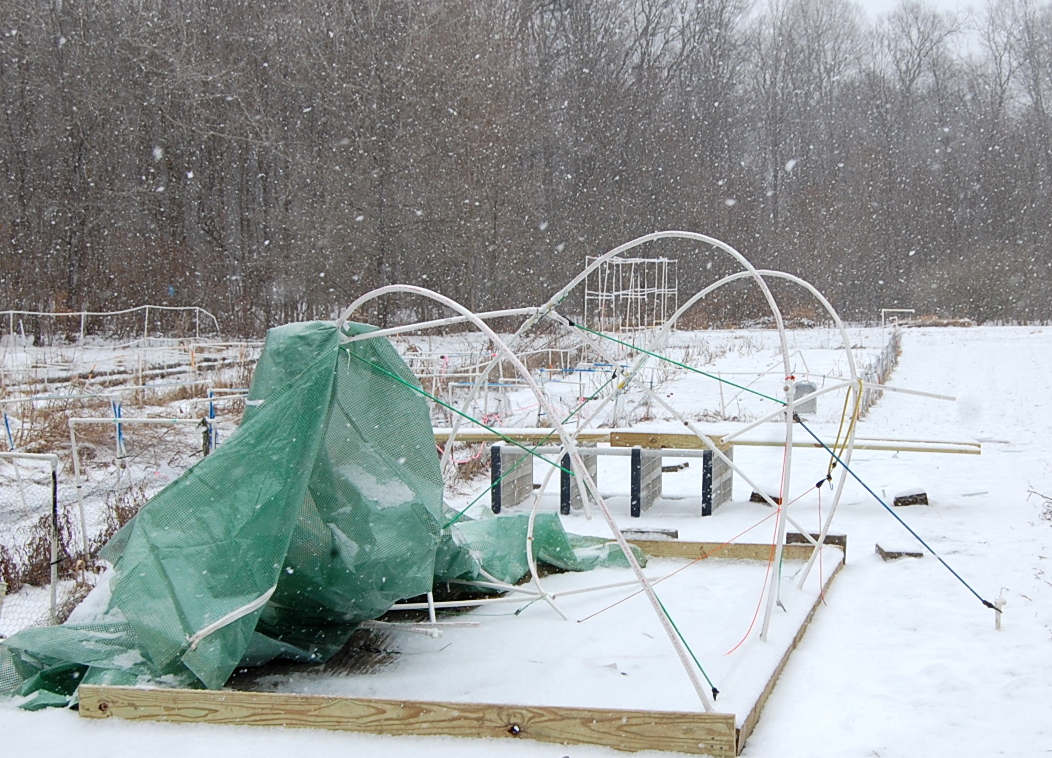 |
| Mr. Hooper Down |
I
flicked the curtains. Fat snow flakes blew around the plastic cover
heaped on the road side of the hoop house, and the exposed ribs
slanted in different directions. By some miracle or engineering
marvel of Spence’s invention, the ribs remained attached to the
foundation. Progress, but not enough for ending my saga or for the
seedlings in the basement. The plants grew taller than the grow
lights. Some burnt against the lights. Others went to seed.
⬇
⬇ ⬇
The
dark moment had come, and mother nature won. No happy ending for my
readers. Maybe they forgot about Mr. Hooper. I could take my stack of
notes outside and watch the wind blow the ideas away.
No.
I
would have a mess of soggy paper wads to clean up. I stuck the notes
in a file folder and put it on the bottom of my writing pile.
Snow
covered Mr. Hooper, and Spence busied himself with fighting lead
poisoning in Cleveland.
Friday,
March first, while I hung laundry in the loft, Spence marched outside
and set Mr. Hooper upright. He returned and rubbed his hands by the
wood stove fire. “My fingers are cold from screwing turnbuckles.”
⬆
⬆ ⬆
After
checking temperatures Tuesday afternoon―outside
14ºF
(-10ºC),
inside Mr. Hooper 50ºF
(10ºC)―he
carried a flat of tatsoi
and mizuna to
the hoop house.
I
gulped so hard I almost swallowed my tongue. Running to grab my
camera and winter jacket, I dashed to Mr. Hooper. “YOU BROUGHT
PLANTS OUT!”
“Just
one tray. It’s an experiment.”
 |
| First Tray of Greens |
I
took twenty photos of the tray. Not much of a climax after all the
ups and downs, but
I’d
done many a wackier
thing in search of a story. Back
inside, I dug out the notes on the Mr. Hooper saga.
Cloudy
skies and snow didn’t favor Spence’s
experiment. Like the
snow covered solar panels in cloudy weather, the snow covered hoop
house
didn’t produce any energy. Mr. Hooper
lost heat. After
Spence went out to poke the snow off its
roof Wednesday
morning,
he carried the tray of curled, crunchy
plants back to the basement. “Their
roots froze. That was
the K.O.D. [kiss of death]”
Thursday
dawned sunny. Keeping
to
his straight line of learning, Spence
dumped five large bags of potting soil into Mr.
Hooper’s
2 ½ by 11 foot raised bed frame. He set out two trays of seedlings
on
the shelves.
Later,
when
I stepped inside the hoop house to admire his progress, I felt warmth
as if I’d stepped close to the wood stove fire.
Spence
pointed to his thermometers―a
balmy 60ºF
(15ºC)
inside,
a warm 40ºF
(4ºC)
in the raised bed soil, and
a chilly
26ºF
(-3ºC)
outside.
“Woohoo!”
I
pumped my fist for
the power of the sun.
“But
I’m bringing the plants
in
this evening. It’s going down to ten tonight.”
Yesterday
afternoon after
I quilted a tree pattern on pane in an attic window wall hanging,
I
spotted
Spence’s red shirt through the hoop house cover. With
camera, jacket, and boots, I squished through the soggy soil and
unzipped the hoop house door. The
spring fragrance of mud mixed
with
new green leaves wafted out. Inside Spence knelt
beside the raised bed and planted
bok choy, mizuna, and
Siberian kale. When
he looked up, sunshine glinted off his safety glasses almost as
dazzling as the glow in his cheeks. He stretched his arm to point to
the flats of plants on the shelves and the row of plants in the
raised bed. “I’ll put row cover over
them before dark.”
So,
after dark, when the wind clanged the porch chimes and howled around
the house, I crossed my fingers, crossed my toes, and silently
chanted Please
let Mr. Hooper stay upright until I finish
my blog tomorrow.
This
morning I pulled back the bedroom curtain, looked into the south
garden, and yelled, “Mr. Hooper’s still there!”
Finally,
a solid, standing end to the saga. Mr. Hooper had its ups and downs
in February. Would it have ins and outs during
March? Whatever. Spence is
happy learning and getting his green thumbs
brown with potting soil. And I can twist my stack of Mr. Hooper note
papers into fire starters for the wood stove.
 |
| Spence Planting Greens in Mr. Hooper's Raised Bed |


