Sunday, October 15, 2017


Reflections on the Fourth Week of Fall – Mystery on the Bottom of the Pool

    Lugging my swim gear, I walked through the YMCA toward the locker rooms.
    Murmurs from workmen laying ceramic tile in the women’s locker room mixed with squeals from the family locker room. Two boys, wearing wet trunks and holding towels over their shoulders like super hero capes, burst through a shower curtain, the temporary door labeled Women Only.
    I skirted the boys and entered the family room to change. Ten more wiggling youngsters jostled each other in line. The new fall schedule placed swim lessons for the preschool class before lap swim on Thursdays. While the children filed out to dress in their classroom upstairs, I dodged flapping arms and calculated that I’d be swimming in more pee than usual.
    Beside the pool, the children’s swim teacher, an Allegheny College student and the lap swim lifeguard, rubbed his hair and face with a towel. The whistle hanging from his on jiggled, and he peeked out from the towel to say, “Good morning.”
    Leeanne, hopping from foot to foot in the first lane, flashed me a welcoming smile. “The water’s warm today.”
    I walked down the stairs, dove under, and came up in the third lane. Though a comfortable temperature, the water wasn’t comfortable. It smelled of chlorine which interacted with unwelcome substances and dried my skin. Taking a deep breath, I pushed my feet against the side and pulled my arms in an arc for breast stroke.
    On the bottom of the pool, between the third and fourth lanes, lay a dark, two-inch blob shaped like a tadpole.
    Had one of the children left more than pee?
    Wearing goggles and looking through water, I couldn’t be sure. Whatever it was, the pool vacuum would suck it up later, and I could take a long, hot shower. I kept swimming.
    Eva, a lifeguard before multiple hip and back surgeries demoted her to lap swimmer, pulled on her pink bathing cap in the fourth lane.
    I switched to side stroke, and we pushed off the wall together. Normally she’d out swim me, but she stopped mid stroke and called the lifeguard.
    Carrying a long aluminum pole with a square foot net at the end, the lifeguard walked around the pool and crouched near Eva.
    She pointed.
    He plunged the net to the bottom and dragged it toward the wall.
    Leeanne kicked her legs and stared at the scooping.
    I finished back stroke and switched to breast stroke. If the lifeguard scooped poop, he’d blow his whistle and close the pool.
    The next time I side-stroked past the netting operation, Eva held the now detached net in her right hand, grabbed the edge of the pool with her left, and hooked her left knee on the edge. Then she ducked under the water. Her out-of-the-water limbs wobbled.
    I swam my sixteenth length, Leeanne dog-paddled, and the netting pair peered at the netted blob.
    Would the next lap be my last?
    No whistle.
    The lifeguard carried the net and pole back to his chair.
    Eva kicked past me.
    Curious, I planned to catch her at one end or the other and ask what they’d found.
    She lapped me twice before I reached the deep end seconds ahead of her. “Eva,” I called.
    She somersaulted under the water, pushed her feet against the side, and headed toward the shallows. She hadn’t heard me and probably wouldn’t stop swimming before I left.
    I could ask the young life guard.
    After swimming my seventy-fourth length, I held the edge of the pool for cooldown leg stretches and rehearsed questions for the guard.
    Did someone poop in the pool?
    Was the poop intact enough that we didn’t have to evacuate?
    Do you ask children to use the bathroom before entering the pool?
    Stretching my arms, I told myself, You’re too shy to ask a person, whose name you don’t even know, such stupid questions.
    When I climbed out of the pool, Leeanne had already left for the showers, and Eva back stroked toward the deep end. I grabbed my swim bag from a hook next to the lifeguard’s chair and said, “Thanks for guarding me.”
    He looked up from his clipboard. “Have a nice day.”
    I hung my bag on a hook in the shower room, pulled out the shampoo bottle, and turned on the shower next to Leeanne.
Buck naked, we had showered next to each other dozens of times. And we’d discussed everything from visiting family to concealing a pistol in her bra when she walked through the woods alone.
    “I’m curious,” I said rubbing shampoo in my hair. “What did they find on the bottom of the pool?”
    Leeanne laughed. “It was a black bead that girls wear in their hair.” Her eyes sparkled. “Good thing it wasn’t what we were all thinking.”


Sunday, October 8, 2017


Reflections on the Third Week of Fall – Harvesting Creek Wood
10-6-17 Driving to the Creek

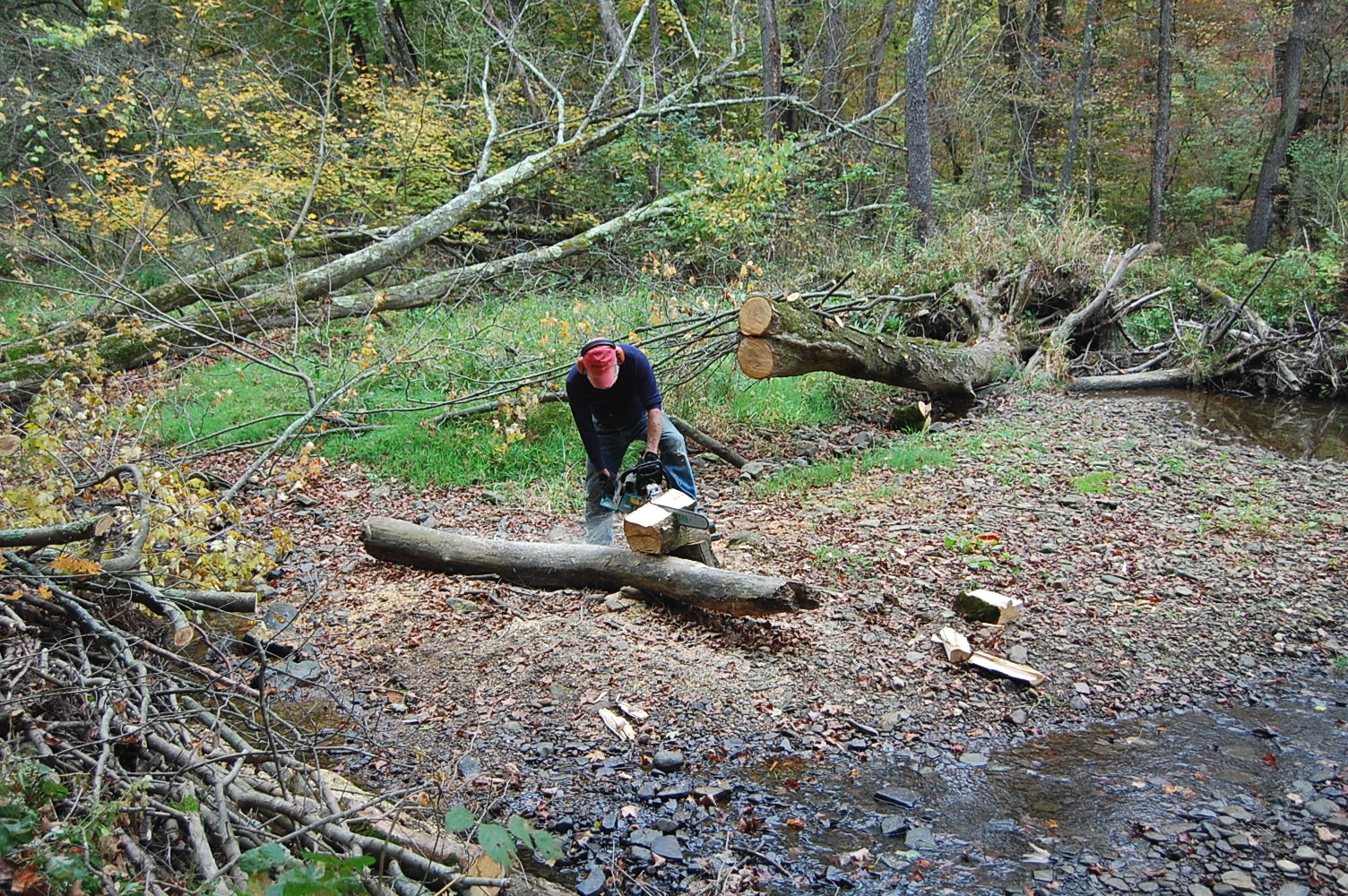
    When October temperatures soared and Deer Creek ran rocky-bottom low, Spence switched from harvesting peppers and potatoes to harvesting the maples downed by spring floods. Harvesting the maples would prevent log jams next spring and provide firewood for the winter of 2018-2019.
    Lugging his chain saw and splitting axe, he baby-stepped down trunks lodged in the bank, giant-stepped over a side stream, then set his tools on his work site, a gravel island.
   He cut.
   The chain saw buzzed, sawdust flew, and a sixteen inch length of mossy trunk thudded to the ground.
   He split. 
   The splitting axe arced overhead and whacked into an upended log. Crack. The log split releasing fragrance of maple.
    He tossed.
    Logs landed thud, thud, thud on the bank beside the tractor.
    He hauled.
    Logs clunked into the tractor bucket. The tractor rumbled up hill. From the lifted and tilted bucket, logs fell into a pile.
   He stacked.
   Criss-crossed on pallets and nestled under tarps, logs dried for wood stove fires.
   Cut, split, toss, haul, stack.
   Cut, split, toss, haul, stack.
   Cut, split, toss, haul, stack.
10-6-17 Cutting
   But this week, unexpected slices of life interrupted his routine.
   First, he’d worn yellow waders, though he said, “I didn’t really need them to cross the trickle of water.”
   Cut, split, toss, haul, stack.
   Cut, split.
   During the splitting, something CRACKED upstream. A roar echoed in the valley, then a rush of muddy, foot-deep water covered the split logs. Since spring floods and the creek habitat had water-saturated these logs, they didn’t float. Spence set his splitting axe on dry gravel and waded into the murky water. He reached in and retrieved the heavy logs one by one. Fifteen minutes later, the water receded.
    Spence stepped across the trickle and drove the tractor with a full bucket of logs to the pallet in the field. Back inside the house, he pulled off his soggy shirt and relaxed with a can of lime fizzy water.
    His second interruption was drier.
    Cut, split, toss, haul, stack.
    Cut, split, toss.
    Yellow jackets gathered by the logs he’d tossed next to the tractor. Had the tossed logs landed near the yellow jackets’ nest? Were they investigating the fresh maple smell?
    With a log or two under each arm, Spence giant-stepped over the trickle, baby-stepped up the trunks lodged in the bank, and edged around wasps to the tractor bucket. Then he reached for one tossed log after another, stowed them in the bucket, and drove away from the yellow jackets.
   Back at the house, he said, "I'll get my tools at dusk."
10-6-17 Splitting
   I interrupted the third time. Curious about his tales of rushing water and the yellow jacket gathering, I followed the tractor through the woods to the creek, perched on the large rear tractor tire, and focused the camera on Spence.
    He cut, split, and tucked logs under his arms. Then he giant-stepped, baby-stepped, and walked to stack the logs in the bucket.
   Cut, split, haul, stack.
   Cut, split, haul, stack.
   After his fourth trip, I said, “You can toss the logs. I’ll move.”
He placed his load in the tractor bucket. “No. Too much chance of an accident.”
    Cut, split, haul, stack.
    The camera clicked.
   Without a single mention of the extra trips my photographing made for his work, Spence carried load after load of logs.
   The logs harvested from the downed maple piled higher and higher. Late next fall, when temperatures drop and Deer Creek runs under snow-dusted ice, this fall’s creek wood harvest will keep us toasty warm.
10-6-17 Carrying


Sunday, October 1, 2017


Reflections on the Second Week of Fall – On a Kayak Built for Two

    Wednesday morning under sunny skies, the old red pickup bounced and rocked down a rutted trail to a dirt launch on Lake Wilhelm. Spence jumped out of the driver’s side. I hustled to set my camera bag out of truck-and-kayak range then met him at the tail gate. With visors of our baseball caps pointing towards each other, we lifted the tandem kayak from the truck bed and carried it to the mud green water. I squealed and wiggled in my new denim shorts. After a spring and summer of too rainy, too busy, and too exhausted postponements, we could finally kayak.
    Camera hanging from my neck, I sat in the bow. Spence pushed the kayak into the water. Oak and maple leaves floated past, then the kayak tilted towards port as if it were a hawk angling for a ninety degree turn. Clutching my camera with both hands, I leaned starboard until the kayak settled. I released the camera, took a deep breath, and pushed the paddle against the sandy bottom. Six feet off shore, Spence dipped his paddle with a whispering swish behind me.
    Guessing Spence’s paddling side and rhythm, I dipped my paddle to match his strokes. The kayak wiggled, and water splashed. Oops, I’d guessed wrong. Laughing with Spence, I stretched my arms straight, dipped, and twisted–great exercise for the abs. My legs toasted in the sunshine and cooled under paddle drips. I couldn’t maintain proper paddling form for long. First my elbows bent. Then my shoulders ached. I set the paddle across the bow and picked up the camera. No problem. Spence never complained about paddling while I rested.
    He angled the kayak toward the bank. “Do you want pictures of the great blue heron?”
    I scanned the bank. Camouflaged against shrubs and trees, the gray-blue bird posed as still as a statue on a branch sticking out of the water. “Sure.”
    Spence pulled, the kayak slipped through ripples, and I clicked photos. When he paddled to within thirty yards of the bank, the heron crouched, opened its wide wings, and flapped into the air. I followed with my zoom lens. Spence steered the kayak. The great blue heron squawked a protest then settled in bushes further up the lake.
    I shoved the camera into its bag and paddled with Spence. Water trickled around the bow. Blue dragonflies raced with the kayak. Random splashes from fish jumping to gulp insects startled me again and again. We zig-zagged through the tricky section with submerged logs.
    Perched atop snags, dozens of cormorants swiveled their heads to watch us. I aimed the camera. With birds moving, water rippling, and Spence paddling, the camera wouldn’t focus.
    “Stop paddling so I can get some pictures,” I called.
    The whispering swish stopped, the kayak settled, and the camera focused.

    Cormorants spread their wings wide. Did they intend to look mighty, or were they drying their wings before take off? One cormorant dove into the water and paddled away. Others pooped then flapped their wings. As if powering down a runway, each cormorant’s feet splashed a series of water plumes until it rose into the air.
    When the cormorants settled on snags across the lake, the kayak tipped side to side as if it were a fish thrashing on a line.
    I clutched the camera to my chest, and threw my hips right then left then right to counteract the wild swings. Why was Spence shaking the kayak?
    “I can’t get the kayak off this log,” Spence said behind me. “You’re going to have to paddle us off.”
    “Okay. When the kayak stops tipping.”
    The kayak stopped tipping.
    I exchanged the camera for the paddle then pulled twice. The kayak slipped free.
    We paddled under the Sheakleyville Road bridge. Echoes of swishing water tempted me. I hooted. The hoots echoed, and Spence chuckled.
    On the north side of the bridge, smooth water encircled an island of lily pads.
    Pop . . . pop . . . pop.
    What’s making that noise?” I set the paddle down and listened.
    “I don’t know.” Spence kept paddling.
    “It’s coming from the lily pads.”
    “What do you want me to do?”
    “Stop so I can figure out what the noise is.”
    Spence paddled the bow into the lily pads.
    Pop . . . pop . . . pop . . . pop.
    Dime sized holes polka dotted the yellowing pads. Insects flew close but didn’t munch. Several pads swayed as if yanked from underneath.
    After five minutes, I sighed and said, “I can’t figure it out.”
    “Me either.” Spence backed us out of the lily pads. “It sounded like water dripping, but there were no drips. A mystery.”
    At the time, we paddled closer to the small birds wading in shallow water covering the spit of land between the restricted nature reserve and the small watercraft part of the lake. Four killdeer scurried, pecked at water covered sand, and turned their heads to study us. What did they think about the green monster with two heads and four legs? They circled and skittered around each other in a charming dance. Then one by one the killdeer hopped or flew to the restricted area while singing dee dee duh, dee dee duh.
    We paddled past the popping lily pads, under the echoing bridge, and out onto the lake with sunshine glittering off ripples.
    Kayaks, the first sign of others paddling on the lake, hugged the far bank.
    Heading back to the launch, I concentrated on proper form–arms straight, dip the paddle, twist the torso–and counted the neon green, blue, or orange kayaks.
    “Sixteen,” I called to Spence.
    “They’re probably a science class,” he said.
    Dip, swish, turn. Dip, swish, turn. Dip, swish, turn.
    My elbows bent, and my shoulders ached. I dropped my arms to my lap. “A gym class more like.”
    With 181 photos in the camera and fresh air in our lungs, we docked at the dirt launch and lifted the kayak onto the truck bed. Visions of birds, lily pads, sunshine, and water swirled through my head and generated enough energy that I could have floated home. Instead, I slid onto the truck seat beside Spence. The old red pickup bounced and rocked up the rutted trail.