Sunday, June 27, 2021

Reflections - Jinxing the Fence

Tomato Blossom

Spence dreams of deer leaping over his garden fence. I’m haunted by earworms of his sad voice saying,
You’ll jinx the fence.


His tomato plant torment began at the end of winter. Night after night, Spence tramped down the spiral stairs to the basement. He tenderly finger-pushed each seed—first Wood’s Famous Brimmer, then Amish Paste, Marglobe, Sub Arctic Plenty, Jersey Devil, and Roma—into his special mix of potting soil and extra perlite. With cats circling his legs, he set trays of planted seeds on heating pads. He watered, transplanted sprouts, and set baby tomato plants under grow lights on a table he’d built for nurturing the precious seedlings. He repeated the process until he had almost two hundred, healthy tomato plants.


In May, he hauled the seedlings to the hoop house to harden off.


The weather didn’t cooperate.


Weeks of temperatures too low or soil too wet delayed planting. The healthy seedlings grew into straggly teenage tomato plants and needed to get into the ground.


I strapped on knee pads, knelt by the string marking row, and dug. The wide trowel scritch-scratched against rocks. I dug deeper and deeper to make room for a handful of Spence’s compost and another of crushed egg shells under each of the eighteen tomato seedlings I transplanted.


Spence could have done the job faster, but he dragged various lengths of pvc pipes to construct the garden fence.


Keeping a safe distance from the scraping trowel and long pipes, robins hopped in the tilled soil and cocked their heads to hunt earthworms.


Progress.


However, Spence returned from his next morning’s garden check with clenched teeth. “A critter ripped out some tomato plants.”


In the garden, ripped-out plants littered the walkways and broken plants stuck in the mud. The critter had also left empty spaces where seedlings had been. Deer prints littered the garden.


“Deer didn’t eat my tomatoes last year.” He growled. “And they were outside the fence all summer.”


Filling in the spaces of lost plants and extending the row a tad, I transplanted eighteen more straggly seedlings. When I brushed against the leaves, they released a pungent, green fragrance.


Spence added sections to the fence and transplanted even more seedlings.


The deer came back.


I helped counter the deer destruction three more times. On one sunny day, Spence, who calls me a delicate butterfly, limited my garden time to forty-five minutes. I would have complained, but the sun spoke louder than Spence. Sweat added a wide, wet band to my sun hat, saturated my sports bra, and rolled off my nose onto wilted tomato plants. Pooped, I welcomed his shooing me inside.


Spence worked on the fence and infilled empty spaces daily.


Last Monday morning, the first full day of summer, he stood by the sliding glass door and hooted. “The doe’s standing in the asparagus patch and staring at the fence. It baffles her.”


Joining Spence and gazing at the five-foot high deer netting held up by pvc pipes, I remembered the times deer netting ensnared my feet. Hooves could get tangled too. No wonder she stared.


The doe ambled to the far end of the south garden, looked longingly through the fence, and left.


View of South Garden from the Deck

“Great!” My mouth watered in anticipation of the sweet, tangy sauce that Spence makes with homegrown Wells Wood tomatoes. “I’ll write a blog about the fence protecting our tomatoes.”


“Don’t!” Spence’s sunny demeanor clouded into a dark thunderhead. “You’ll jinx the fence.” And later that afternoon, as if to underscore his warning about my blog topic, he tilted his head toward the north garden blueberry cage where he’d help lift a cover cloth over the seven foot high frame. “You can say we’re getting old. We hardly argued.”


I fastened the cloth to the frame with a cable tie. “I’ve already written about blueberries. Twice.”


“You can never have too many blueberry stories.”


I didn’t take his advice. Instead of forcing a blueberry story out of nothing, I pondered an arc for the obvious conflict of the deer and the tomato seedlings. 


The next morning, Spence slung open the glass door and shouted. “Get out of my garden!” He turned to the cats and me. “Did you see that? The doe was in the garden. She leapt over my fence to get away.” He clenched his fists and shook his shoulders as if to rid himself of the image.


Perhaps I jinxed the fence.


Your thoughts aren’t connected to the deer’s stomach.


I should have listened to his plea and worked on a boring blueberry saga.


Deer eat five hundred kinds of plants. They take what’s available.


But the deer didn’t eat tomatoes last year.


They were trellised last year. Weather kept Spence from building the trellises first this year.


Wednesday morning, Spence came back from his garden check with slumped shoulders. “I’m crying over my lost tomatoes.” He plunked his straw sunhat on top of the coat stand. “What’s the use of planting more. The deer will just eat them.”


Spence had a point. He’d planned for six or seven tomato rows. Of the hundred and ten seedlings we planted in four rows, deer destroyed over sixty before we got a single green tomato. With all the infilling, Spence will be lucky to start the fifth row.


“It’s just chaos out there now.” He scowled at the garden through the glass door.


Rubbing his back, I gazed at the garden too. His plan of keeping the six varieties of tomatoes in separate sections got jumbled by infilling empty spaces. Deer ate plants nearly as fast as Spence replaced them. He had a limited number of plants while the deer had all summer to gobble. To top it off, nature, which abhors a vacuum, filled every cubic millimeter of bare soil with weeds—

a very different picture from the neat garden the first day I’d helped Spence.


Fortunately, he didn’t give up. He infilled and rebuilt torn parts of the fence. Next week he’ll buy more deer netting to replace the ripped parts and more row cover cloth to baffle the deer. “I’ll hang the row cover over the deer netting. If they can’t see where they’re going, they won’t jump in.”


The first tomato formed on a Sub Arctic Plenty plant, and when I asked Spence if he had a chore for me in the garden he said, “You might as well infill tomatoes. The deer are running out of things to eat.”


He dreams of deer leaping into the garden.


I hear his sad-voice warning.


But we still hope for fresh-from-the-vine, ripe tomatoes.


First Tomato - Sub Arctic Plenty


BLUEBERRY BLOGS

“Blueberry Bunnies” July 7, 2019

“Cat-Escaping Craziness” June 28, 2020


Sunday, June 13, 2021

 Reflections - Melodies for Richard

Red-Winged Blackbird

Stuffing masks into our pockets, Spence and I walked into Brugger Funeral Home Friday, June 4. Unmasked, suited men on either side of the atrium inclined their heads and, in unison, said, “Welcome.”


Directions would have been more helpful, but I inclined my head back and walked down the marble hall until I spotted a sign above a doorway. Michael, for my second cousin Richard Douglas Michael.


He was eleven years older than me. We saw each other at family gatherings on Edith’s (his aunt’s, my great aunt’s) farm. I ran beside the brook with other children. He talked and laughed with the young adults on the rise by the breezeway. Over the years, he greeted me at family funerals with a broad smile that lit his rosy cheeks. I sat near him at the luncheon after Aunt Edith’s service. He related an adventure of climbing a pole for Penelec in gusting winds.


“You mean,” I asked in awe, “while we’re huddled at home waiting for the electricity to come on, you’re climbing the utility pole in the snowstorm?”


He chuckled. “That’s right.”


His wife Charlene gazed up at him with love and admiration.


I’d never top his pole climbing to help people, but I hoped by attending his funeral and saying goodbye to Richard in person, I would support his wife and sisters.


With Spence following, I stepped into the Michael room. Aisles separated the eight-chair middle section from the narrower side sections. Seventy to eighty unmasked strangers sat between me and Richard’s open casket in front. I whispered to Spence, “We don’t need our masks.” Shivering, half in thrill and half in unease of finding myself in a group so large after more than a year of pandemic isolation, I scanned the room for Richard’s sisters.


His older sister Norma, who taught both Spence and me junior high biology, sat in the last row. With backs to us, neither she nor her husband Bob saw us enter. Not wanting to shout and knowing I wouldn’t be heard over the murmur of conversations, I reached my hand toward Bob’s shoulder. A woman at the end of the row, who Norma would later introduce as their daughter Kathy, motioned for Bob to turn around before I made contact.


The three stood. When Bob and Norma last visited us at Wells Wood, conversations had flowed. But, after Norma’s alto, “I’m glad you came,” and Bob’s bass “Good to see you,” silence fell. With the pandemic more under control, I wasn’t sure how to greet someone I hadn’t seen for a couple of years. Bob stretched his hand to Spence. The rest of us nodded like bobbleheads.


From the front of the room, Charlene glided toward us. She wrapped me in a bear hug. “Thank you for coming.”


“I’m so sorry, Charlene,” I said breaking away. “At least you had a long time together.”


She glanced toward the casket. “We did. Sixty years,” and she smiled Richard’s broad smile before stepping aside to make room for Nancy, Richard’s younger sister.


More bobblehead nods. Our greetings would have amused Richard.


“How is your quilting coming?” I asked after condolences and thanks were exchanged.


“Fine. Friday is the day I’m with my quilting friends . . .” Her voice trailed off at the reminder of why she missed the gathering that day. “I make pottery now too.”


Grateful I’d had time to connect with relatives, I sat between Norma and Spence.


Is it wrong to enjoy a funeral?


Norma leaned toward me. “The people in the rows ahead of us are relatives.” Then she pointed to specific people. "There’s Little Richard, one of Richard’s four sons.” Her litany continued, names muddled in my head, and the music started. Norma pointed to the woman playing an electric keyboard. “That’s the sister of—.” She said a name, but I forgot.


Sitting on a bench, the musician stared at music resting on a wide rack, played, and sang a song I hadn’t heard before. The words flowed from her heart, but her pitch only blended with the melody half of the time.


Taking steps in time with the music, Reverend Mark O’Hern, as tall and slender as one of the utility poles Richard had climbed, entered. Reverend O’Hern prayed, praised Richard with facts that matched those in the obituary, and prayed some more. The service ended with the reverend leaving while the musician played the same song.


Screenshot of Richard's Obituary

Halfway through, the music rack popped loose. It fell backward sending a white binder up then down adding an unwritten percussive thud to the song.


Relatives in front of me straightened in their chairs.


The musician sang and played without the music.


A man near her picked up the rack and pressed it against the keyboard frame.


The rack fell back to the floor.


The woman kept playing and singing.


He pressed.


The rack fell.


After his third failed attempt, she stopped. “Hold the music for me,” she said to the man trying yet again to attach the loose rack. To the rest of us she said, “If you know the words, sing along.”


No one sang. Many laughed. I bit my lip so I wouldn’t snicker and checked if Richard wore his wide smile. He didn’t, of course.


Is it wrong to enjoy a funeral?


The music stopped. A funeral director gave announcements in a comforting voice, and we left for our cars.


Spence and I came last in the procession. That suited me fine. All the other cars were freshly-washed city clean. Our Subaru wore its perpetual outer coating of West Creek Road dirt. I concentrated on speeding up and slowing down to keep close, but not too close, to the gray car ahead.


Cottonwood seeds floated past the windshield. Tires hummed on the pavement like a muted drumroll. Flashers blinked and orange funeral flags flapped on each of the nearly thirty vehicles stretched out on the gentle rises and dips in front of me. I silently thanked the stopped drivers for their patience and reveled in the fitting tribute for Richard.


Though running red lights had bothered my elementary-school teacher ethics at first, by the time we neared the cemetery, running red lights made me giddy.


Is it wrong to enjoy a funeral?


The procession wove around curving cemetery lanes and past row after row of American flags left from Memorial Day celebrations.


A man, wearing an orange vest over his suit coat, waved for us to park at the end of the long line. By the time we’d walked to the gathering at a tent, the grandson and granddaughter pallbearers had Richard’s flag-covered casket in place. Spence and I stood outside the tent.


Reverend Mark O’Hern began the service with prayers. A red-winged blackbird sang conk-la-ree.


Two servicemen lifted the flag off the casket, folded the flag with precision, and presented it to Charlene. The red-wing whistled.


The servicemen hustled to join the waiting honor guard. One grabbed a flag. The other grabbed a rifle. The guard shot three eardrum-breaking salutes into the air. The red-winged blackbird commented, chack, chack, chack.


The serviceman at the end of the line dropped his cane and lifted a bugle to his lips. Slow, mournful notes of taps moistened my eyes, and the accompanying red-wing’s trills had me checking my pockets for a handkerchief. None. The cloth mask worked just as well.


Last, Reverend O’Hern invited people to sprinkle holy water on Richard’s casket.


Charlene sprinkled first. She handed the bottle to Nancy then walked to the edge of the tent. Tears streamed down Charlene’s face, but she stood erect and kept her eyes focused on the casket.


Nancy sprinkled water then tapped the casket as if giving her older brother pats on the back.


After Norma sprinkled, she joined us. “I didn’t come to mourn Richard. I came to celebrate him. He had a good, long life.” She turned for one last look at the casket, and the red-winged blackbird trilled.


Now, when I hear a red-wing sing, I’ll remember Richard and the melodies from his funeral.


It isn’t wrong to enjoy a funeral.

Red-winged Blackbird


Sunday, May 30, 2021

 Reflections - I Can See Clearly Now

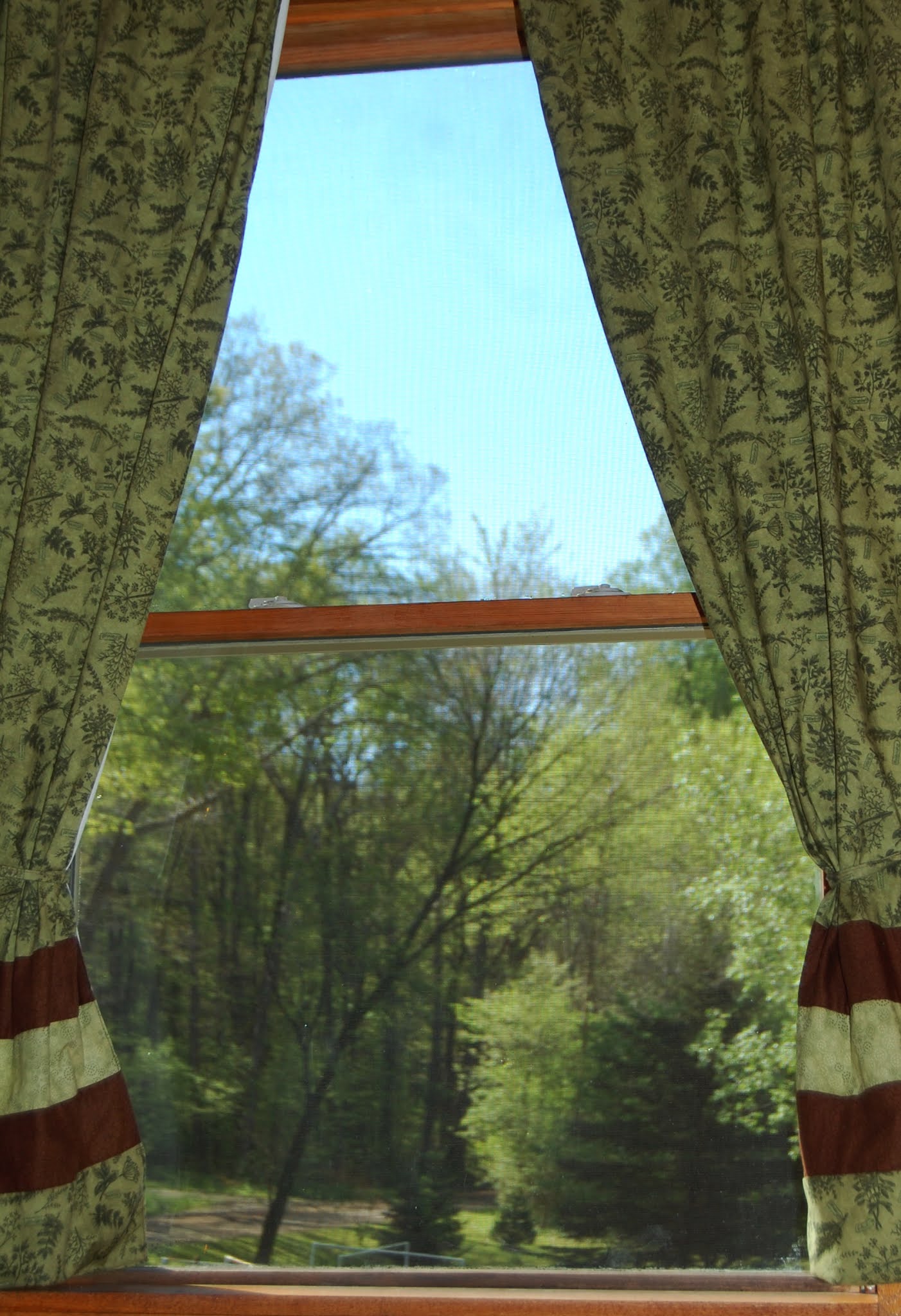
Bedroom Window

“Your windows frame the outside making nature look more beautiful.”

My daughter’s 2006 comment, when she’d first looked out our log house windows, still motivates me to wash them—especially before her visits. Since she planned to come the last week of May, I washed windows the first two warm, dry days in the third week.


Bad choice.


On Monday May 17, when the temperature rose to hair-sweating warmth, I mixed window washing solution in a spray bottle and gathered rags.


Three cats followed me to the bedroom.


Taking down the curtains I’d sewed to coordinate with my log cabin quilt, I carefully laid them on the bed.


The cats pranced over them exploring their unusual placement.


I pulled the top window down a crack, pushed the bottom up a foot, and unlatched the screen. Ready to yell for Spence if one of the furry fellas jumped outside, I stuck my elbows out as wide as airplane wings and angled the screen inside.


Its metal edges scraped against the window frame.


The cats tore off the bed and scratched the wood floor in their escape to the great room. I marched out behind them with the offending three by five-foot monster, and they exploded into a frantic chase.


Glad to leave them, I stepped onto the porch. Cicadas droned in the woods. A cat bird warbled a concerto of its neighbors songs. The wet rag swished against the soft plastic screen. Leaving the screen on the porch to dry, I headed back to the bedroom.


The cats scurried behind me.


I sprayed washing solution onto the window.


Six cat ears twitched.


The rag squeaked across the glass.


Six cat ears flattened.


Clusters of carpenter bees hovered outside the window. Buzzing and maneuvering in a weird ballet, they zoomed toward the window. Boink. One bounced off the glass.


Six cat ears straightened.


The carpenter bees must have picked that warm, sunny day as perfect weather for boring nesting chambers in the log house. Spence would have lots of round, quarter to half-inch diameter holes to caulk.


Boink. Boink.


The repeated bee bashing against the window made me nervous. Not nervous that they’d sting—males can’t and females don’t unless they’re handled. Nervous that when I yanked the window off its tracks and tilted it inward to clean the outside, bees would fly in and cats would jump out.


“Spence!” Toting the rags and the spray bottle, I found my husband working on the bid package for the township’s French mattress project. “Will you set the step ladder up by the front bedroom window?”


Having fallen off ladders, he takes them seriously. 


So I could set up the ladder myself for the other first floor windows, I studied his techniques—press levers and shift the ladder around until it doesn’t rock.


“That’s steady enough.” He hustled back to his paperwork.


I climbed to the second step from the top, squirted, and inhaled the aroma of vinegar mixed with fragrance of white narcissus. Robins hopped in the grass. They alternated cocking their heads to listen for worms and to monitor the human trying in vain to fly. Three cat noses pressed against the inside of the clean window. 


Cats and robins would have accompanied the window washing any day, but the carpenter bees hadn’t been this numerous before. Buzzing bees whirled around me. Their sound escalated to incoming-missile decibel when one dove for the window.


Carpenter Bee

As if peak bee hovering weren’t enough, roadmaster Dan picked that day to deal with the pot holes in our dirt road. His grader scraped past Wells Wood four times turning the road surface into an inch of powdery dirt. His assistant Dave followed in a dump truck pulling a spring-tooth harrow
which drew parallel lines through the dust. He stopped and shouted, “It’s like making a Zen garden.”


Passing vehicles created dust clouds. They rose and floated toward the house. A tow truck driver hauling a car on its flat bed spotted me, braked, and crept past. Dust still rose behind him.


Spence ambled back to see if I’d fallen off the ladder. “The window looks better.” He gave me a thumbs up.


A red sedan stopped. The electrical inspector leaned out of the passenger window and said, “There’s a hell of a lot of dust.”


While he and Spence chatted, I replaced the screen.


Maybe I should have waited for a day without dust.


Wash on a rainy day when the road’s muddy.


I want a dry day without dust.


Wait until winter.


But Ellen’s coming next week.


She won’t care about a week’s worth of dust.


Except for me moving and positioning the step ladder, cleaning the next windows went the same with investigating cats, hovering bees, and rising dust. Hopefully the screens would catch most of the dust.


Having exhausted themselves, the cats curled for naps. Relief. Loft windows came next. Because I would NEVER climb twenty-five feet up the heavy extension ladder, I had to tilt loft windows inward. I could press the plastic track and pull the bottom one in, but I needed Spence to press while I balanced the bottom window and yanked the top. With the cats sound asleep and being high off the ground, I figured the cats, dust, and bees wouldn’t interfere.


I got a third of that right.


A pickup dashed by raising a cloud of dust as wide as the road and higher than the telephone wires. At least the cloud thinned out at the top.


Carpenter bees favored the logs near the peak of the roof as much as the first floor ones. Instead of banging against the glass, they flew right in. I flicked the rag to shoo them out and squirted vinegar water at one heading in. It jerked back and hovered. I squirted again. It flinched but didn’t retreat. Lest I annoy a female bee by accident, I reverted to the flicking-rag method.


By the end of the afternoon, I had half the log house windows washed. Dave spayed brine to lessen the dust. He only treated the middle of the road because that’s where country folks drive.


Tuesday brought less drama.


Though dust clouds floated toward the house, the brine kept the dust at tailgate height. I only needed my rag-flicking technique for the crank-out windows above the kitchen sink. I could stand on the porch and deck to wash the outside of others. That eliminated ladder balancing. And the cats only glanced at my now familiar cleaning tasks—until I went out to the porch and slid Spence’s summer desk away from the great room window.


A mouse, with three or four babies clinging to her back, scampered from the folded floating row cover and ducked under the paper cutter.


Long after I’d cleaned that window, replaced its screen, and muscled the desk back in place, the cats occupied the log hewn table on the inside. Staring out, their heads moved in unison as if watching a tennis match. Rills swiped his paw at the mice on the other side of the glass. At least I’d provided the cats with a clear view.


Last, I cleaned the sliding glass door. Ande leaped between the door to peek at me and the window to monitor the mice. A few carpenter bees slammed into the glass. Sunshine warmed my back.


I rubbed the last smear away and stepped back.


Wow!


Ande and the great room disappeared. In their place reflections—of pansies, the dirt road, and trees stretching into a cornflower blue sky—wavered.


I would tell Ellen. Even looking in, windows frame the outside making nature look more beautiful.

Reflections in Sliding Glass Door

Sunday, May 16, 2021

 Reflections - Joyce

 
Whoops-a-Daisy Shasta Daisy

Margaret Joyce Brown

April 16, 1930 - April 29, 2021 


Super welcoming Joyce rescued Spence and me when roundabouts thoroughly confused us, and we ended up miles away from her house in England. We telephone from an inn. She drove, leading us in our rental car, to a place we’d been within a block of earlier. Over lunch, which resembled a Thanksgiving feast, we chatted with Joyce and her husband Joseph. Puzzled about groundhogs, she quizzed us about the critters. We corresponded for years. She always asked about groundhogs. And Joyce introduced us to her neighbors Chris and John, who continue corresponding—especially on February 2, Groundhog Day and Candlemas.


Gracious, engaged, kind. Joyce will be missed. 


With Jennifer W., Spence and I planted a Whoops-a-Daisy Shasta Daisy for Joyce. The daisy graces the house number sign.


Sunday, May 2, 2021

 Reflections - Gauntlet of Geezers


On April 22, a snowy Thursday morning, I drove around the bend on West Creek Road and gasped. I’d planned to accelerate to a dust-raising, zipping-along speed for the scenic, four-mile drive to Carlton post office. Instead, I slammed my foot on the brake pedal.


I don’t always sail through the intersection of West Creek and Creek. Sometimes I slow to wave at Dan driving the township grader or Kathy heading out to the store. I also pause for the occasional dashing deer, ambling black bear, or trotting turkey. I’d never stopped for a traffic snarl of SUVs and pickups.


Though I had the right-of-way, vehicles maneuvered as if my little white Crosstrek were invisible. Pulling out of the line that parked half on the berm and half on the road, a black SUV turned downhill toward the bridge over Deer Creek. A red pickup squeezed past and headed east on Creek Road. The four other vehicles followed.


Puzzled, I joined the end of the line. Since none of the vehicles had parked by the bridge, I ruled out fish fanatics. Fishing season had started April 3 and the stocked trout were hooked—or hook-wary—by April 4. Perhaps the drivers had watched a state trooper clear an accident. Maybe they belonged to a hunting group and scouted for turkey prints in the snow. Turkey hunting season would begin in eight days.


I glanced at the dashboard clock. Ten-thirty. Our local post office is only open from nine to eleven weekdays. It’s rude to pop in on Stacy when she’s closing up, but I had time even with the vehicles moving at my husband’s cautious, don’t-stir-up-dust pace.


The line stopped at the intersection of Creek and North. Again, the vehicles parked half on the berm and half on the road. This time they’d joined others lining North Road down to the bridge over Deer Creek. When I pulled out to pass the metal pack, a gray-haired man opened his pickup door and hopped down in front of my car.


Gritting my teeth, I crept forward and caught a glimpse of a boxy white truck. If it was a Pennsylvania Fish and Boat Commission stocking truck, that would explain the traffic. Gray-haired groupies always gathered to watch the commission officer release trout into Deer Creek.


For the remaining mile and a half of dirt road, I wound around mimicking the curves in Deer Creek. I didn’t encounter any more vehicles until my tires had whined over the iron mesh bridge, and I rounded the bend leading to the Kid’s Fishing Area. A lone SUV parked by the entrance. No children and no accompanying adults were in sight.


Congratulating myself for escaping the crowd, I turned on the hard road to Carlton, zoomed up the hill past fields, then glided down through the woods toward French Creek. An approaching gray pickup with zigzagging red-orange flames on the side made my stomach contract. Hutch. My neighbor. He drives in the middle of the road and steers toward anything, or anybody, he wants a closer look at. I eased onto the narrow berm.


He jerked back into his lane. Since he didn’t wave, he must not have recognized my car.


Gripping the steering wheel, I made it to the light blue cottage—half post office, half private residence—without encountering any more vehicles. I parked beside Stacy’s gray sedan with her kayaking sticker, I could use a good paddle. After the crazy men drivers, I could use some female conversation. I checked the dashboard clock. Ten forty-five. Plenty of time. I tied on my mask and walked inside.


“Good morning, Janet.” Stacy usually pulled her long hair up in a bun to reveal dangling earrings. Today she let it fall past her shoulders and cover the top of suspenders.


“Morning.” I handed her an overweight birthday card. “Is the fish and boat commission stocking Deer Creek today?”


Deer Creek

“Possibly. You could check their schedule online.” She placed the envelope on the scale and printed the postage. “Has Spence been working in your garden? I planted my onions and garlic two days ago, but with this snow . . .”


Mesmerized by the scarlet griffins woven into her suspenders, I wondered if she’d lost weight so her belt didn’t fit. “He has plants growing in the hoop house. His garlic’s ready to transplant.”


“Not in today’s snow. Maybe tomorrow.” She pressed the postage onto the envelope. “My best to Spence.”


Untying the mask, I hoped the gathering of pickups and SUVs had dispersed.


It hadn’t.


It had increased.


At the Kid’s Fishing Area vehicles parked on both sides of the road leaving a single lane open. Old men wandered around the boxy white truck and stood beside a long tube extending from the bottom of the truck to the creek. A young commission officer stood on top of the truck. He dipped a net into one corner, brought it up full of squirming trout, and emptied the flip-flopping fish into a transparent, fabric funnel. The packed trout thrashed making the funnel bulge and wiggle.


For a moment, I considered parking for a better look. However, all the gawkers were guys, and they’d probably snicker at me if I joined the crowd wearing a mask. Besides, Spence would think I’d had an accident if I didn’t get home soon.


Taking a deep yoga breath, I crept through the gauntlet of geezers without meeting oncoming traffic. I relaxed and exhaled.


Unfortunately, two pickups had parked on the iron mesh bridge. A man, ignoring my approaching car, crisscrossed the bridge carrying fishing gear. He hustled to catch the trout that had been in the stream less than fifteen minutes.


Lifting my foot off the gas pedal, I let the car slow to a crawl.


To my horror, Hutch’s gray pickup rolled down Jacobs Road, through the stop sign, and onto Creek Road inches in front of my bumper. Sheesh. Following him would be more frustrating than driving past him. He crossed the bridge at 10 mph then sped up to 20 for the mile and a half drive home. That gave me plenty of time to think. I didn’t need to check online. The men had gathered for fish stocking. But, I did need to check the stocking schedule before venturing out to the post office next April.

Pansy in Snow