Sunday, November 13, 2022

 Reflections - Leaf Man

Spence Raking Leaves on West Creek Road

We don’t agree. Spence views leaf composting as a recipe. To me it’s a nightmare.

I admit I didn’t hold this position until 1:30 p.m. on October 27 when I sat in a Grove City Hospital pre-op, post-op room—but I’m getting ahead of myself. 


The second week of October, Spence and I ambled along West Creek Road under an array of gold, rust, and crimson foliage. I inhaled the fragrance of decaying leaves. Spence scanned the berm and pointed at a leaf pile. “I’ll collect those for compost.”


“Nature will turn them into compost.”


“My recipe works faster.” 


“Recipe?” I stooped to pet a woolly caterpillar with a long orange middle. The unappreciative wriggler curled into a ball.                


“Carbon, nitrogen.” He extended a finger for each ingredient. “Air and a little water.”


“Leaves, your main ingredient, are carbon. What’s the nitrogen?”


“Tom and Kathy’s cow manure.” He glanced in the direction of their farm. “I layer six tractor buckets of leaves. Then spread one bucket of manure.” He swirled his hands over an imaginary plain. “It’s like mixing pizza dough. Only the compost shrinks, not rises. So I stir it up. I don’t punch it down.”


“May I photograph you gathering leaves?”


“Another time.” Still super-protective, because of my September 26 surgery, he guided me up the freshly stained ramp and through the front door. “You need to rest in princess mode.”


The rumble of Spence’s compact tractor outside several days later sent me scrambling for my cell phone—not as heavy as the camera. I hustled outside and followed the noise up West Creek Road.


Spence jumped off his cherry red Mahindra and pushed both hands down a couple of times. “Slow down.”


“I didn’t want to miss getting pictures.” Rounding the tractor, I focused the camera on Spence.


“You’re in plenty of time.” With the blessing of the township roadmaster, who curses leaves clogging the drainage ditches, Spence raked. With strokes as smooth as ballet dancer’s movements, his rake scraped along the berm, in and out of ditches. Spence formed a leaf mound, resembling a windrow, which ran along the edge of the dirt road. Mounting the tractor, he set the speed icon at turtle-low, crept along, and scooped leaves into the six-cubic-foot front bucket. He hopped down, raked more, and stuffed bunches into corners.


Laying the rake on top of the leaves, Spence put the tractor in gear and trundled down the road, around the garage, to the compost piles in the field below the north garden.


I ambled after.


To keep wind from liberating the leaves, Spence put three-foot chicken wire around the piles—a seven-foot diameter circle around one and a nine-by-seven foot oval around the other. His leaf haul whooshed out of the bucket. Spence raked the leaves to smooth the piles and prevent clumping. “I’m ready for more manure.”


Spence Dumping Leaves onto Compost Pile

Though he’d already hauled manure this season, he called our friends again. “Hey, Tom and Kathy. This is Spence. I’ll be down for more manure. I hope it’s convenient for you.” He hung up and slipped into work boots.

“They already gave you permission. Why did you call again?”


“Because it’s polite. And they might shoot,” he bent to fasten the Velcro straps, “if they thought a stranger was robbing their manure pile.”


I didn’t ask the obvious, What thief would steal manure? Instead, I said, “They aren’t hunters. They won’t have guns.”


“They do have guns.” He stepped onto the porch. “To shoot predators stalking their animals.”


And I didn’t accompany him on the three-mile drive. With the Mahindra speed lever pushed to the top rabbit-icon, the trip’s still tedious. I pestered for details on his return.


The manure pile is eighteen feet high, shaped like a pyramid, and an eighth of a mile downhill from the barn. “It’s next to the upper cow pasture. Cows don’t pay any attention. The bull is curious. He comes to the fence and watches,” Spence said. Lowering the bucket to ground level, Spence drove into the freshest part of the pile, lifted the bucket, and backed up. He used the hay fork to rearrange the manure in the bucket so it wouldn't fall out. Then he evened out the load and cleaned any mess that fell on the ground. 


Hearing the tractor rumbling back, I grabbed my cell phone and headed to the compost piles. 


Spence forked the steaming manure onto the leaves. “Later I’ll add lime. It sweetens the mix for bacteria.” He raked the manure smooth. “I’ll add kitchen scraps too. That attracts—”


“Worms.” I knew from years of tending a worm factory to generate compost for my pansies and strawberries. “They eat the leaves and poop, soil enrichment.”


By October 25, Spence had collected thirty-four tractor buckets of leaves and six of manure, establishing the compost piles before his surgery to repair a long-standing hernia. 


Spence Forking Manure onto Compost Pile


That brings me to 1:30 p.m. at Grove City Hospital on Thursday, October 27 and my nightmare.


The hospital sent a text alerting me that Spence was in recovery. I envisioned him dozing to the melody of beeping monitors, but Spence said he’d been wide awake. The anesthesia made him chatty. Ignoring the nurses monitoring his vitals, Spence listened to their dog stories and contributed escapades of his impish buddy Rills. 


Alone in Spence’s pre-op, post-op room, I perched on a princess pillow and tweaked my deck blog. Dr. Sciullo paused at the doorway and, without a hello or everything’s going to be fine, blurted, “He had a decent sized hernia.” The doctor shook his head, seemingly impressed with the hernia’s magnitude. “You got to hold him back for a couple of weeks so he can heal. I know he likes to do all those outdoor things.” And, giving me no time to thank the doctor or ask a question, he hustled off. 


Hold Spence back from leaf collecting or “outdoor things” as Dr. Sciullo put it? My nightmare.


Waiting to be wheeled into the operating room, Spence had wiggled his toes in brown hospital socks. “Leaves are piled across from Rob’s. I’ll collect them Monday. Maybe Tuesday.”


Nature provided plenty of leaves. Cows kept the manure coming. Spence had acres of garden to spread the compost on. He wanted to make more. How could I stop him?


Easing around curves and slowing for our bumpy dirt road, I drove Spence home from the hospital. He immediately concocted a pizza on a pita bread for himself. At least he let me wash the dishes.


Over the weekend he cooked three meals a day, insisted on accompanying me for half hour health walks, and persisted in scooping cat litter boxes. I’d done the last task before my surgery and could have resumed it, but Spence insisted I rest after writing at my desk for an hour. He got on all fours so his incision would only ache, not sear through him like a hot fire poker.


Though Spence pampered me following my operation, he followed a different principle for himself. What doesn’t kill you makes you stronger.


At least it rained Monday. Figuring he couldn’t collect leaves, I relaxed. I shouldn’t have. 


Instead of hopping onto his tractor, he hopped into his hot pepper red Maverick, drove to Meadville, and shopped—at Giant Eagle, Get Go, Home Depot, the Post Office, and Auto Zone. 


While he was gone, the phone rang. A chipper voice said, “I’m a nurse from AHN. May I speak with Spencer?”


Gulp. I’d flunked my hold-him-back directive. “He’s not here right now. May I take a message?”


“Maybe you can answer my questions. I’m calling to follow up on how he’s doing after his surgery.”


Admit failure? No, I lied. “He missed driving his new hybrid truck so much, he took it out for a ride.”


Peals of laughter came through the line. “That’s good.” Without saying goodbye, she hung up.


Pale-faced and foot-dragging on his return, Spence laughed at the missing-his-truck story too. He set a couple of small grocery bags on the kitchen table, reached for extra strength Tylenol, and collapsed onto the sofa for a long nap.


Our son Charlie brought in the rest of Spence’s purchases.


I did a rain dance. It worked for a few days.


Spence busied himself polishing an analysis of the two approaches to lead poisoning—poisoned babies and poisoned houses—for an opinion piece in the Cleveland Plain Dealer. He attended ZOOM meetings and called folks about lead issues. He even let me drive him to his diabetes eye exam. We made it through one week without any leaf man tractor driving.


The beginning of the second week, Spence nudged Rills off his lap, pulled the sweats he wears for pajamas down, and traced a finger around his glued incision. “I’ll rake when the swelling’s down.”


Alarmed, I cut Gilbert’s morning cuddle short and dropped the tabby into a chair. “Maybe it would be better to wait until after you see Dr. Sciullo on the fifteenth.”


“No. Raking builds muscles.” He walked to the dresser for his clothes. “Don’t worry.”


As if! Dr Sciullo hadn’t charged Spence with the impossible directive. 


The next several mornings I abandoned my usual, How did you sleep, greeting and asked Spence, “Is your swelling down?”


He grumbled sad negatives until he said, “No. It’s up.”


“Up?”


He held his hand where his left legs met his torso. “It was swollen below the incision.” He moved his hand to mid abdomen level. “It’s swollen above now. Progress.”


Wherever the swellings, they kept him off the tractor. They didn’t prevent him risking all day outings to Cleveland in his new hybrid Maverick averaging over fifty miles a gallon—twice. 


The first trip fell on a Friday, eight days after his surgery and a fifth of the time past mine. He left Wells Wood at 9:00 a.m. calling over his shoulder, “Charlie can do laundry. Let him help you.”


Waving, I didn’t argue. Our son wouldn’t return from work until early afternoon. Dr. Ackenbom had given permission for me to lift twenty pounds. Feeling strong and invincible, I belted out Helen Reddy’s “I Am Woman” and sorted dirty laundry.


However, Spence’s day-long trip—driving to Cleveland, racing from meeting to meeting, and shopping at several stores without the possibility of taking a nap—ignited the worry monster in my stomach. 


The phone rang three times before noon.


The first time I dried my soapy hands and picked up the receiver to hear Spence's concerned voice ask, “How are you?’


“Fine. Just washing the breakfast dishes.”


“Okay, take it easy today.”


On the second call he asked, “Are you resting?”


Luckily, I’d finished clearing the kitchen clutter, feeding the worms, scooping the litter boxes, and pushing the setting buttons for the first load of laundry. “Yep. I’m in princess mode on the bed working on the next blog.”


A sigh came through the line so loud that it woke Ande, who’d been snoozing beside me, and set his pointy cat ears twitching.


Spence didn’t ask about my health on the third call. He said, “I bought you five pie pumpkins. They cost a dollar each.” We chatted about freezing pumpkin puree before he casually slipped in his main question. “So, what are you doing?”


During his second trip to Cleveland, he only sent texts reminding me to rest. 


My nightmare ends in two days. I hope. I’d planned to drive Spence to his post-op appointment like he drives me to mine.


He vetoed that. “I can drive myself. You’re welcome to ride along.”


I’ll go, of course—dreading Dr. Sciullo’s ire because I didn’t hold Spence back enough. Realistically, only anesthesia could have done that. Spence scribbles to do lists and forges ahead. I’m betting he’s smart enough to run his body within its limit rather than risk being barred from future leaf man activities.

 
Spence Mixing Manure with Leaves

Sunday, October 30, 2022

 Reflections - Handymen on Deck! (Part Two) 

Sinking Deck with All Vegetation Except Hops Removed

Spence warned me. “They’re handymen. “Don’t get your hopes up.”

Too late. My hopes soared. I imagined rolling my yoga mat on a flat deck and stretching without toppling over.


Our two year search for help with the sinking post, slanting deck, and peeling stain had ended. Within weeks, we would have a flat, stable, newly finished deck. Nathan said he would repair the deck as soon as we cleared the weeds. Sparky said he’d come Sunday, August 28, to spec the refinishing job. Setting a sickle, pruning shears, garden shears, and loppers on the porch, Spence said, “Use these for weeding.”


What could possibly go wrong?


Sparky, Dave Sparks, came with his assistant Dave. Though both are pleasant and polite, they’re easy to distinguish. Dave is taller, leaner, and less talkative than Sparky. He chatted, paced the deck and jotted notes.


Spence showed Sparky the Behr card with a product that promised to cover treated wood, but Sparky recommended something else because “That stuff goes on like concrete. You can’t stop in the middle without leaving a mark.”


“Do the staining for sure. If Nathan doesn't show . . .” Spence threw his arms in the air. “Repair the deck too.”


“I have two jobs in front of you.” Sparky tucked his notebook into a shirt pocket. “I can start in about two weeks, weather permitting.”


Motivated by Sparky's “two weeks,” I slipped into garden gloves, grabbed tools off the porch, and marched to the edge of the green thicket. I scanned for snakes, mice, and voles before whacking, chopping, and yanking. No critters popped out. They must have heard the destruction and scooted. I also unwound woody stems from the lattice below the deck and left a waist high pile of vegetation for Spence to haul.


Spence hauled and weeded after dinner, a time when he declared himself too brain dead for computer work.


We each weeded several more times, and, with only a couple square feet left on Friday, Spence said, “I’m driving to Nathan’s. I’ll let him know we’re ready.”


I assumed Spence would leave Nathan a note. Spence’s account of his trip proved me wrong. He pulled into Nathan’s driveway and jotted a note while talking to a yippy-little dog. Nathan came home so Spence crumpled the note, shoved it into his pocket, and told Nathan we were ready. “Nathan said, ‘okay.’ He’s a man of few words.”


The next day, Spence pulled the last of the vegetation away from below the deck. He left the hops—one of his favorite plants. It bears flowers with an earthy fragrance. He also removed the lattices that encouraged vines to climb, balanced the lattices atop the tractor bucket, and hauled the wobbly load to the garage basement. He sprayed industrial strength vinegar on the ground to discourage the weeds. We really were ready for Nathan.


Nathan didn’t come.


Spence and I spent another four days of tag team yanking, clipping, and hauling. We untangled the last vines from the ramp spindles—ready for Sparky, who had to refinish not only the ramp, deck, and steps to the porch, but the railings connecting all three.


Nathan still didn’t come.


Sparky called several times. “I didn’t want you thinking I forgot you, Miss Janet. The rain is delaying this job. I’ll have a price for you soon.”


“Calculate the whole job, Sparky—fixing the sinking post and staining. The other handyman didn’t show.”


Rain and more rain pushed the start date back.


Friday morning, September 23, Sparky’s pickup pulled onto the gravel driveway. He and his helper Dave muscled an aluminum frame holding an empty 300 gallon plastic water tank down the driveway—Sparky waved at me watching from the porch—around the house, and into the side yard. “Tell Spence to fill the tank over the weekend.”


If all went according to Sparky’s three day work schedule, and allowing for a few days of rain, he would complete the project by the end of September.


Using the rainwater from our 500 gallon cistern, Spence filled Sparky’s tank half full that afternoon.


The tank emptied itself overnight.


I called Sparky.


“Don’t worry, Miss Janet.” His jovial voice reassured me. “There must be a leak. I’ll fix it when I come Tuesday. Sorry about the water you lost.”


Heavy rain over the weekend and Monday replaced some of the water.


Sparky couldn’t fix the leak. He, Dave, and Spence stood by the tank and discussed water sources. They settled on dropping a pump into the cistern. “I’ll bring a pump next time,” Sparky said.


Switching their attention to the sinking posts, Dave fetched the posthole digger and shovel. Tools scraped against dirt outside.


Inside, my son Charlie led me to the loft for the first of many princess movies. By the time Turning Red credits scrolled on the screen, rain splattered the deck, the handymen had left, and Spence offered an invitation. “Are you up for a stroll?”


“Not far.” I slipped into sloggers, grabbed an umbrella, and ambled to the deck. “It’s level!”


“They jacked it up.” Spence flashed a toothy grin. “The center post had rotted. They poured concrete beside it.” He leaned over the railing and pointed. “For the new post.”


The rain kept the handymen away until Thursday. That morning cat ears twitched with the thunk, thunk of digging two new postholes, buzz, buzz of sawing supports, rumble, rumble of the dolly rolling heavy flower pots to the front yard, and shish, shish of spraying bleach on wood.


Sparky Bleaching the Ramp


Sparky removed the top of our 500 gallon cistern and dropped the sump pump in.


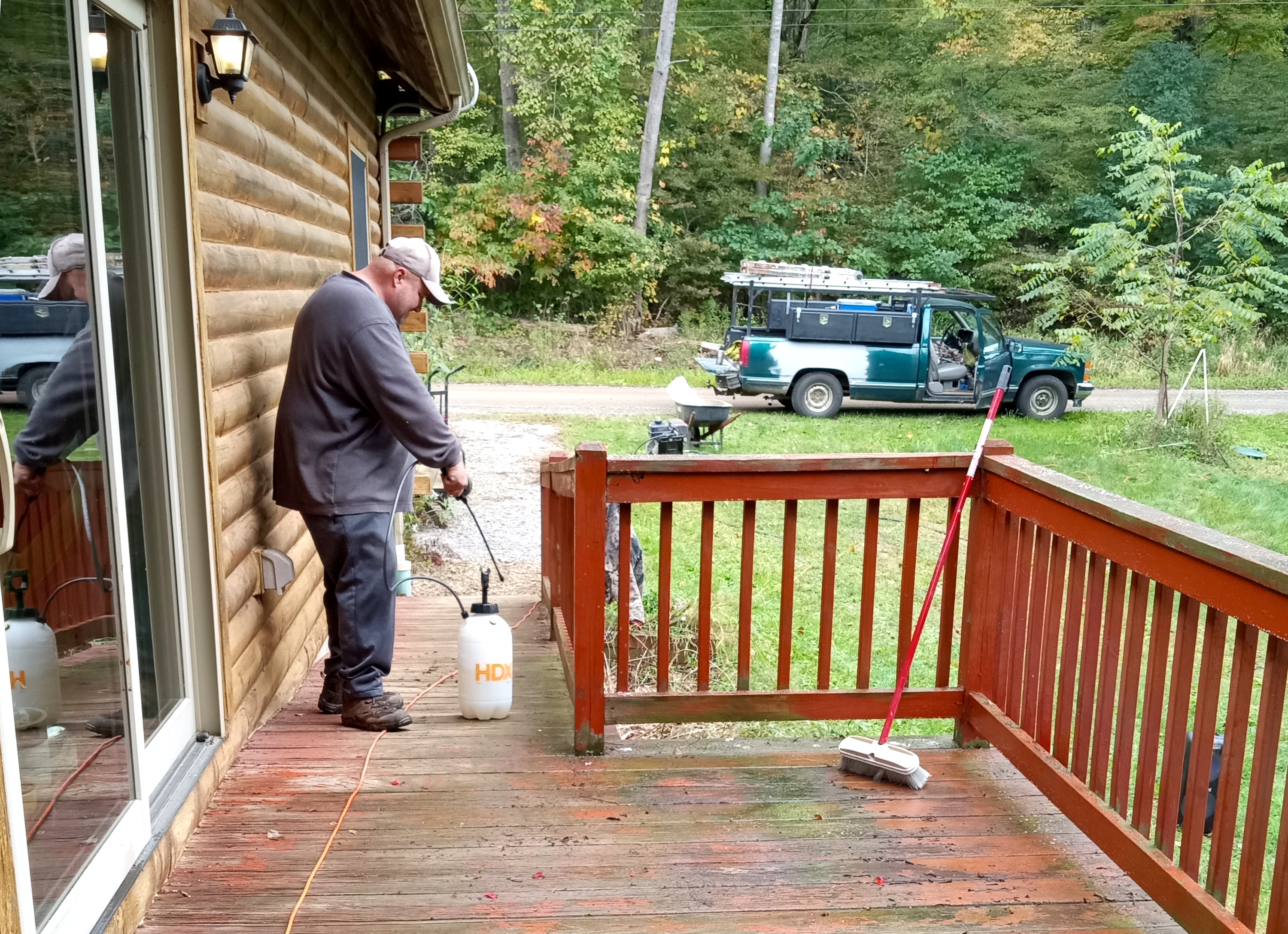
Dave waved the power washer wand over the bottom of the ramp.


Rumble, rumble, rrrrr. Rumble, rumble, rrrrr.


Four feet into the job, Sparky stopped Dave and came to the door. “We’re not getting enough pressure from the pump for the power washer.” He adjusted his baseball cap. “I don't want to burn out the motor. I’m going home to see if I can get my other pump working. If not, I'll rent one.”


Friday, they finished setting the three posts—the replacement for the rotten center post and two extra posts for support. Then they inserted the second pump into the cistern. It worked. The power washer burnt out. “I’ll work on my two power washers over the weekend. If I can’t get one working, I’ll rent one,” Sparky said with a pleasant smile.


I would have kicked the dratted machines and given them a few choice words in my teacher-voice.


Whether rented or repaired, all the machines worked Monday.


Three mesmerized tabby cats lined up by the sliding glass door to watch the fellas as if they performed a Broadway musical complete with costumes. Wearing knee-high rubber boots, camouflage pants, and a red baseball cap, Dave swept soapy water with a wide push broom. Sparky—in slate blue Bermuda shorts, red shirt, and a bandanna on his head—sprayed the suds away. For the finale, the handymen carried their tools off deck. They left shiny-wet boards, muddy dregs at the bottom of the cistern, and three exhausted cats.


The next day, the fellas pried out rotten wood and hammered in new pieces.


With Rills supervising from his perch on the kitchen windowsill, Dave taped and covered the porch floor and anything that shouldn't be marred by airborne stain. Sparky sprayed stain with smooth, experienced strokes onto the porch spindles. Dave climbed a step ladder to reach the high support posts.


The ladder tipped.


I winced.


Dave grabbed the post, righted the ladder, and casually brushed more stain.


Sparky and Dave touched up spots on October 5, finishing the job. In the kitchen, Sparky spread papers listing work hours and supplies on the table. He added a pile of receipts then explained the adjustments in price from his original estimate.


I wrote a check.


The deck looked lovely and would outlast our lifetimes. I let my imagination soar. I would roll the yoga mat beside pots of pansies and stretch to Yoga with Adriene videos next spring.


Realty topped that.


At my four week post-surgery checkup on October 25, Dr. Ackenbom’s face mask dimpled. “I give you an ‘A’ plus,” she said in a gleeful voice and lifted some restrictions, giving me permission to do yoga. “As long as it feels good.”


Back at Wells Wood, I rolled my yoga mat beside pots of begonias and mums then selected Adriene's low-to-the-ground, gentle, yoga in the park video. The Second Summer sunshine toasted my back. Ladybugs crawled across my hands. A breeze brought browning white pine needles and the spicy fragrance of mums. Yoga stretches did feel good—especially on the flat, freshly stained deck.

 
Mums and Begonias on Repaired and Refinished Deck

Sunday, October 16, 2022

 Reflections - Handymen on Deck? 

Deck Sinking at Center Post

Inch by inch the center post of the deck sank. The railing dipped and the deck floor slanted—both pointing toward the deviant post. Inquiries to Spence got me a pat on the back and “Yes, it’s unattractive. No, the deck won’t collapse. Don’t worry.”

But the sinking deck had hidden danger.


Lugging my yoga gear onto the tilting deck, I rolled my mat beside the pansies and begonias before tuning in a Yoga with Adriene video on the laptop. Clouds floated overhead. The morning bird chorus cheered me on.


Adriene placed a foot against her opposite leg, chatted instructions, and raised her arms over her head into tree pose. She stood straight and strong like a solid oak.


At age seventy-four with essential tremor, or the wibble-wobbles as Spence calls it, balancing challenges me. Standing on one foot with the deck slanting, I swayed like a willow in a storm. I raised one hand. The other clutched the sliding glass door handle to save myself from toppling over.


In his younger years, Spence could have hoisted the deck with a jack and poured a new footer to fix the sinking post. Awaiting hernia surgery at the age of seventy-five—not an option.


Besides, the second half of the problem involved stain peeling off the treated wood. Summer after summer Spence had sanded and swept the old finish then brushed and rolled on a new—in vain.


For the sake of my wibble-wobbles, his hernia, and the wood, we needed help.


In the fall of 2020, we called Sparky, Dave Sparks of Sparky’s Handyman Services, because he’d done a terrific job refinishing the ladder-sides of the house and garage two years earlier. 


Spence and I gave Sparky a tour of the sinking deck. He paced the length, pulled a notebook out of his shirt pocket, and jotted measurements. 


I handed him the Behr color chart from Home Depot and pointed to California Rustic.” I want that one.”


“I keep staining.” Spence put his fists on his hips. “It keeps peeling.” He pointed to the paint chart. “That product is advertised to work.”


Sparky gritted his teeth and tilted his head on an angle. “That’ll peel too. They make a better product that covers waterproof wood.” He added my color preference to his notes and stuffed the notebook into his pocket. “But I’m busy now. I might not get to the job till spring.”


“That’s okay. I won’t be doing yoga outside with the weather turning cooler.”


Sparky shook our hands and gave us reassuring smiles. “I’ll call you.”


Spring 2021 arrived. I rolled my yoga mat up the slant from the pansy pots. Sparky didn’t call.


Spence called him and left messages. “Hey, Sparky. It’s Spence on West Creek. We still want the deck fixed.”


Sitting on the sofa with feet propped on the coffee table, Spence dialed Sparky’s number yet again. “Hi, Sparky.” Spence’s eyes darted back and forth. His feet slapped against the floor. His back straightened. “I’m sorry . . . I understand . . . okay . . . take care.”


Twisting a dish towel, I waited for an explanation.


Spence got off the sofa. “That was uncomfortable. Sparky said ‘I can’t talk now. I’m driving my mother to hospice.” Spence fetched a can of carbonated lime water. “I heard the car motor in the background.” He took a long swig of his drink. “I could hear Sparky’s mother too.”


We waited the rest of spring, all of summer, and into fall. No word from Sparky.


Spence left more messages.


Sparky still didn’t call.


Snow fell. The latest coat of stain peeled more. The post sunk further. When I rolled the yoga mat on the slanting deck in spring of 2022, we searched for a new handyman.


Spence stopped at local work sites. “Do you guys fix decks?” They didn’t but suggested handymen. Spence called, left messages, and pinned slips of paper with contact information to our bulletin board.


I cut a handyman ad from the Area Shopper, called and left a message. A few days later, a pickup with ladders slowed while the driver gawked at the deck. He didn’t stop.


Spence collected names at Amish stores—Adrian’s cabinet making shop and Windy Knoll Grocery.


I called Father & Son Labor Work, a handyman service listed in the Mercer County phone book. A week later a man with a heavy European accent called. He interrupted my explanation of the deck problems. “Where are you?”


I gave him the address.


“Where is that?”


In the middle of my directions from Greenville, he harrumphed. “Too far,” and hung up.


Spence drove his new Maverick pickup to show Tom, the neighbor who dug the foundations for our house and garage. Spence asked about handymen too, of course.


“Nathan on Jacob’s Road.” Tom peered at the Maverick’s dashboard with dials and icons on screens. “Nathan’s Amish. Leave him a note.”


Spence wrote a note and drove to the renovated farmhouse which, with its dark brown siding and covered porches, made a great advertisement for a handyman. Spence gave the note to Nathan’s wife—a young, petite blond with a welcoming smile—who assured Spence that Nathan could fit our job into his schedule.


Nathan didn’t contact us.


We asked other neighbors. They had no suggestions.


And a neighbor asked us. On our health walk along Creek Road, Spence and I’d reached Barb’s Victorian house when Sandi, a township auditor, stopped her car. She turned off her engine and, well into a country chat asked, “Do you know a handyman I can call?”


We exchanged weary glances. I summarized our search from Sparky and his mother to the thick-accented hanger-upper.


Sandi frowned. “I’ll ask Barb then.”


“We gave Barb Sparky’s number.” Spence pointed to Barb’s house. “For her new steps.”


“The one driving his mother to hospice,” I said for clarification.


Sandi slumped behind the wheel. “Well, I know two contractors. Maybe one of their workers could do your deck. I’ll tell them to expect your call. At least they’ll call you back.”


The first, a son of Sandi’s friend, didn't call us back. The second, minister of the community church in Milledgeville, answered Spence’s call. The minister-contractor said he couldn’t possibly come by until Saturday. I waited that entire day. He didn’t show and or call.


Two dozen notes hung on the bulletin board. We still didn’t have anyone to fix the deck.


End of summer girasoles bloomed. Spence drove to Nathan’s house and left another note.


When Spence returned, I asked, “Do you mind if I call Sparky?”


“If you want.” Spence glanced through the sliding glass door at the slanting desk. “Don’t count on him calling back.”


Wild turkeys clucked in the woods. Telemarketers called—no handymen, no contractors. I resigned myself to practicing yoga on a slope.


On the morning of August 24, Spence walked to the garage to fetch travel notes he’d left in the Maverick. I scooped up cats for morning cuddles. Gravel crunched in the house driveway. Holding Gilbert, I peeked out the guest room window.


Two men jumped out of a black pickup and talked to Spence. I assumed they asked for permission to hunt in our woods this fall, but Spence led them to the deck. I put Gilbert down, picked up Rills, and moved to the sliding glass doors. The men motioned with their hands, chatted, and then left.


“Nathan saw me walking. He told his driver to stop.” Spence said when he returned and reached to scratch Rills. “Nathan will fix the deck.”


“When?” I released the wriggling cat.


“As soon as we cut the weeds.”


Clematis


The clematis, wisteria, and hops had been joined by touch-me-nots, wild blackberries, and an assortment of less desirable intruders making a massive green thicket around the base of the deck. “Did he quote a price or give you a number to call?”


“No. I’ll buy the supplies. He wants two posts. And fifteen bags of concrete. They’re eighty pounds each.”


“Not with your hernia.” Shaking my head for emphasis made me dizzy.


“He’s Amish. He doesn't drive.” Spence used his explaining-to-a-child voice. “I can buy Home Depot cards at Giant Eagle. I’ll get gas points for the Maverick.”


“NO. WAY.”


“The Home Depot guys will load the bags. I’ll slide them off.” He pantomimed the unloading with his hands. “It’ll be fine.”


My stomach churned as if making butter. Spence planned to get the supplies, and we didn’t have a price, phone number, or contract. But Nathan was our only offer—until that evening.


Spence’s lawn mower hummed outside while I splashed dishwater inside. The phone rang.


“Hello, Miss Janet.” Sparky’s jovial voice vibrated through the landline.


I tightened my grip on the phone.


“You may not want me anymore. I understand-—”


“Sparky!” I blurted. “It’s good to hear your voice. How are you? How did things work out with your mother?”


“She died.”


“I’m so sorry.”


“It’s been crazy. My father moved in with me. Home’s settling down. Not work. It’s awfully busy. But if you haven’t found anybody yet, I could look at the job Sunday morning.”


“Someone came about the job this morning, but he didn’t give us a price, a contract, or a start date. And Spence said he’d get the eighty pound bags of concrete for him. I don’t like that. Please come.”


When Spence finished mowing, I relayed the Sparky news. 


Spence half smiled. “Huh.”


“After two years of no handymen, now we have two.” I twisted my pony tail. “I don’t want to turn either down. It’s too hard finding help.” 


“Don’t worry.” Spence held my shoulders and squeezed. “We’ll split the job. Nathan can repair the deck. Sparky can do the finish. But—”


Spence pulled me in for a hug. “They’re handymen. Don’t get your hopes up.” 

Sparky


END PART ONE